
The 22LR has been a favorite for target shooting, casual plinking and hunting for well over a century (138 years, as of today). The original load involved a 40-grain lead bullet pushed by about four grains of black powder at close to 1,100 fps. This load made the 22LR, offering accuracy, affordability and mild report. When smokeless powder caught up with the little rimfire, early offerings kept the same parameters.
Not long after this transition, advances in powder technology made it possible to increase the original velocity past the supersonic mark without exceeding the original pressure limits. Substantially increasing the muzzle energy over the original loads, these “super velocity”, “hyper” or “mini-magnum” 22LR also increased the little cartridge’s range by flattening its oh-so-19th century trajectory a bit.
However, pushing the little round’s speed over the sound barrier means that the bullet may pass below it at some point as it travels towards its intended target, depending of course on the distance of that target. Should the bullet drop below the supersonic into the transonic and/or subsonic zone before impact, the trajectory will become more complex, and any velocity variations is likely to impact trajectory.
The anti-goldilocks transonic speed
When a projectile travels above the speed of sound, its pressure wave (sound wave) follows behind it. At subsonic speed, this pressure wave precedes the projectile. In both cases, the influence of the pressure wave on the ballistics of the bullet is rather constant and predictable.
The issue arises when a supersonic projectile slows down from the supersonic to the subsonic velocity range. The transition is not instant: the projectile passes through the transonic stage, which is a ballistic thorn on the side of any shooter whose projectile encounter it on its way to the mark.
At transonic speeds, the pressure wave that had been trailing the projectile at supersonic speed catches up with it as it slows down, until it finally passes in front of it when the projectile becomes fully subsonic. Since the slowing down of the bullet is a gradual process and takes time, a portion of the flight will be under transonic conditions. As the pressure wave rides up from the backside to the nose of the bullet, it wreaks havoc on its accuracy potential.
Furthermore, the supersonic threshold may vary during the flight itself, depending on micro-variations of atmospheric conditions like temperature and humidity along the trajectory. This means that bullets could exit and re-enter supersonic, transonic and subsonic conditions more than once, at the increased expense of downrange accuracy.
The transonic range and its negative effects happen between roughly 1,150 and 1,070 fps. For initially supersonic 22LR, that loath speed range happens rather quickly and over short distances, because their initial velocity is not that far above the speed of sound and their light projectiles and their poor ballistic coefficients shed speed very quickly. This means that the bullet will quickly fall into the transonic stage and start misbehaving. Add to this inconsistent ammunition with large velocity extreme spread, and you have a recipe for ballistic disaster.
Many current supersonic 22LR ammunitions are currently available. What separates them, other than the initial velocity, is their overall manufacturing quality and consistency. Better made ammo will exhibit tighter extreme spreads, lower standard variation and overall more uniform trajectories thanks to more controlled manufacturing processes. This comes with a literal cost: this high-grade ammunition can cost more per round than some affordable centerfirerifle loads, not to mention that this specialized offering is not commonly found in stores.
Since most of us can’t afford such high-quality rimfire ammunition, let’s explore the influence of the initial velocity of off-the-shelf 22LR ammunition on its accuracy at 50 yards, and find out which parameters, if any, are the most influential.
The Test
For this experiment, I selected 9 22LR loads, and shot five, 5-shot groups with each at 50 yards, while recording the velocity of each shot using an Athlon RangeCraft Pro Velocity radar chronograph.
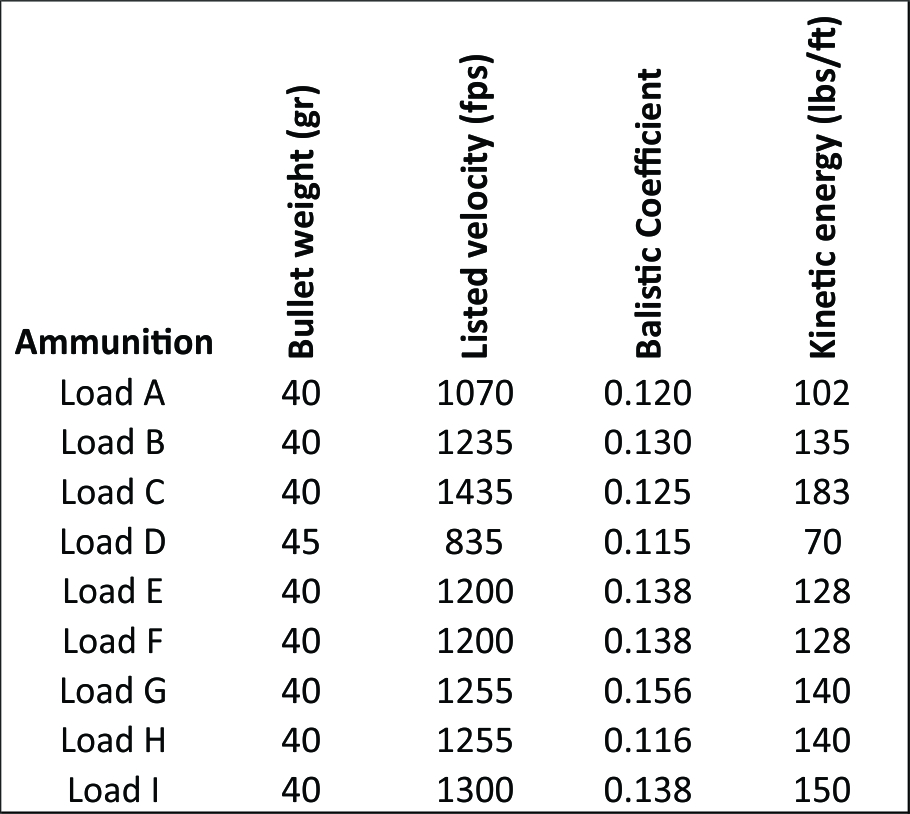
Using Microsoft excel, I calculated the velocity average, median, standard deviation, minimum and maximum and extreme spreads. All groups were measured with a dial caliper on the widest outside holes, with one caliber deducted from this measurement, giving center-to-center 5-shot groups. I do not mention the brand or load of the ammunition involved in this test, simply to avoid taking the focus off the velocity and its influence on accuracy.
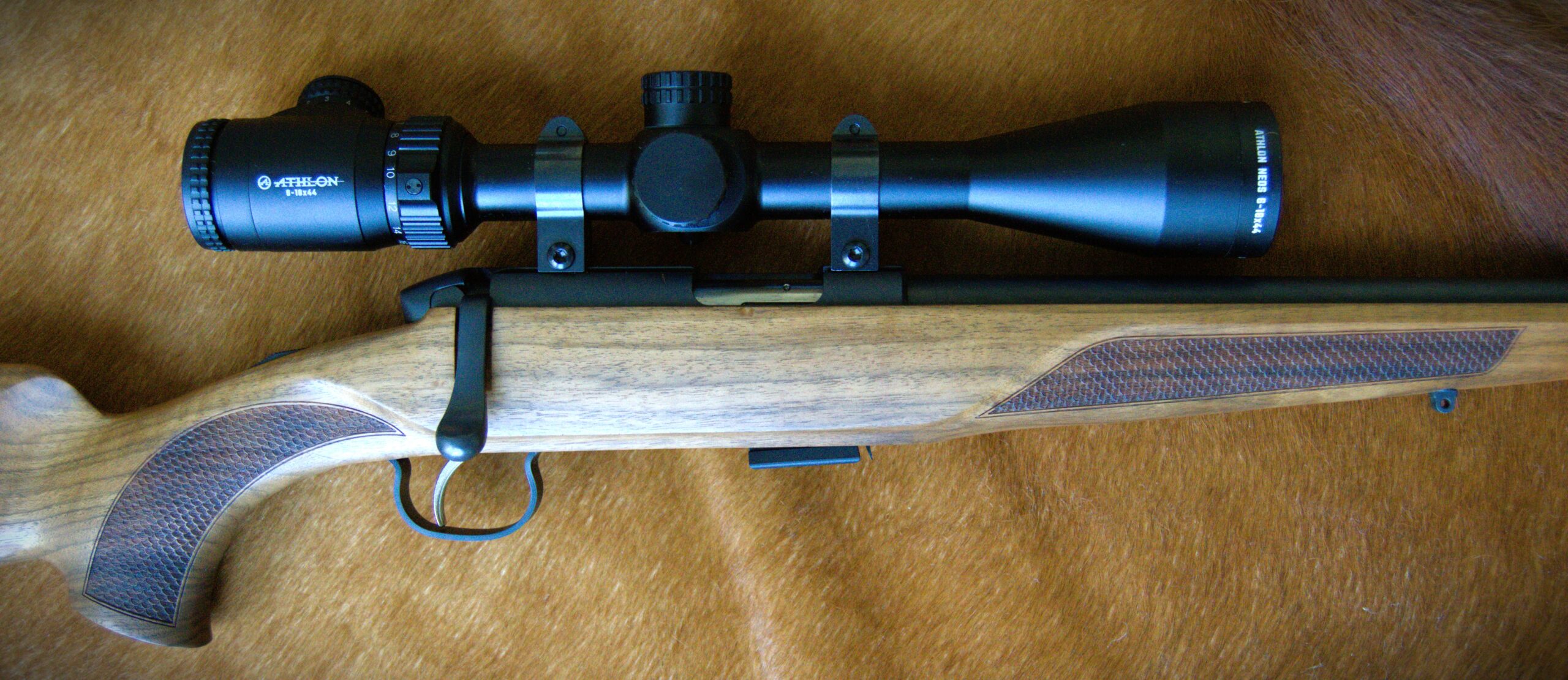
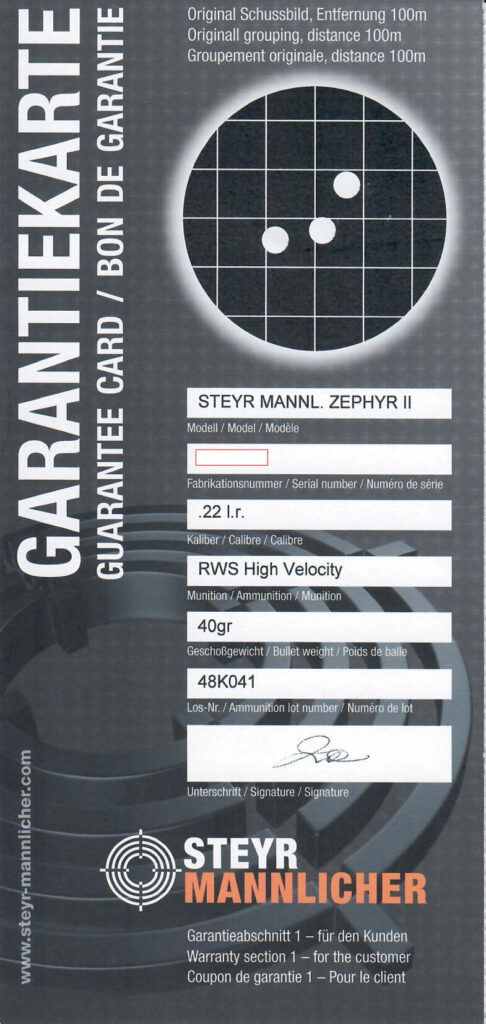
This little experiment would not be telling anybody much if the gun used was not accurate enough to fit the purpose of the test. It turns out I am lucky to have a true gem of 22LR rifle on hand. My little Steyr Mannlicher Zephyr II 22LR came from the factory with a test target showing a 0.724 inch center-to-center three-shot group shot at 100 meters (109.36 yards), with RWS High Velocity 40 grain ammunition (lot # 48K041), certified by the signature of the tester. This means that this little rimfire rifle shot a 0.63 minute of angle single 3-shot group, better than many centerfire rifles.
Also, keep in mind that I shot the groups for this experiment outside and from sandbags. My shooting skills are adequate but certainly do not match the repeatability of a machine rest. While there is a possibility the groups would have been tighter had the rifle been shot from a fully supported rest, all group size difference should be at least relatively comparable, as they were shot under the same conditions.
Using their respective ballistic coefficients, I ran the different loads minimum and maximum values in Federal’s great online ballistic calculator to see at which distance each load would drop below the subsonic threshold that day. For the current temperature and elevation that day, this threshold was calculated a 1,154 fps. This distance is given as a range in the main figure below.
Terminal accuracy
The accuracy results are extremely interesting. The digitized groups and the associated velocity statistics are presented in the rather large figure below (click/tap to zoom in):
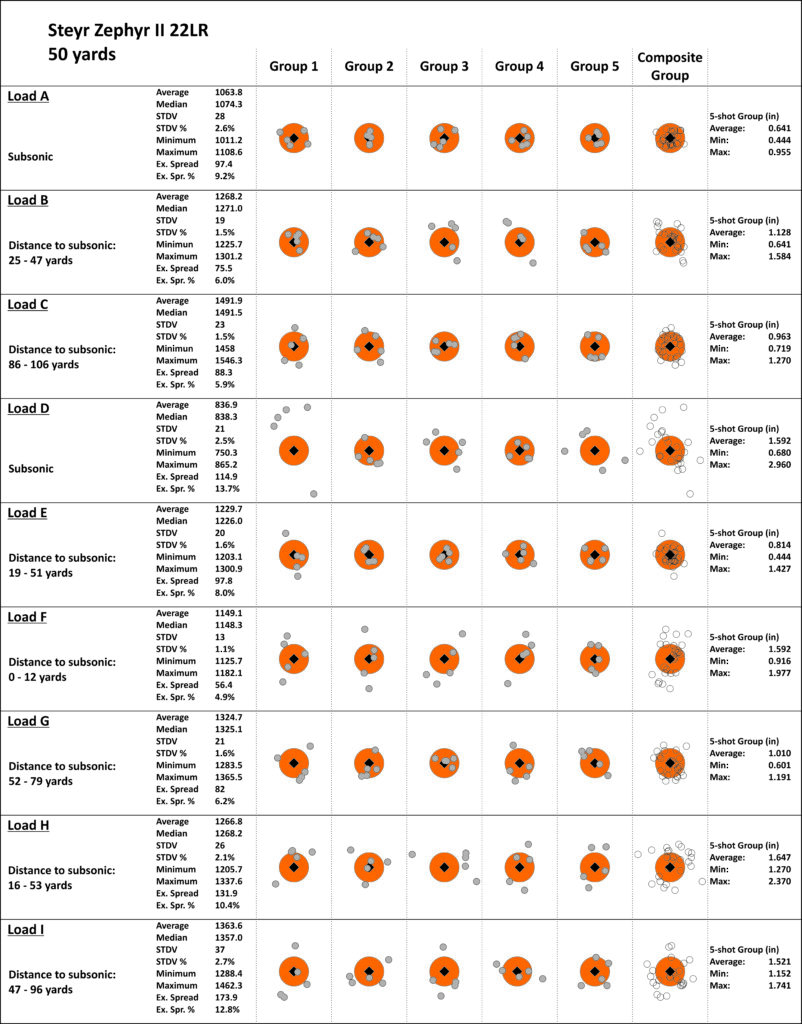
Three loads grouped less than an inch on average, but only Load A stayed below an inch altogether, largest 5-shot group included. This load also ties with Load E for the smallest group of that test (0.444’’ center-to-center).
Seven loads out of the nine printed smallest groups under one inch (loads A, B, C, D, E, F and G), but out of these seven, five loads have maximum groups at least double the size of their smallest (loads B, D, E, F and G).
Four loads averaged above 1.5 inch on average (loads D, F, H and I). Loads D and F show widely spread groups and less spread-out groups, though load F is a wee bit tighter with a 1.977’’ maximum group compared to Load D’s largest 2.960’’. Loads H and I are consistently spread out with most of the shots being peripheral rather than close to the center of the mark.
Load E would have comparable accuracy to Load A if it weren’t for two shots printing significantly above and below the mark in the first group. Velocity readings of these two shots happened to be the maximum and minimum values recorded out of 25 shots.
Finally, the composite groups show that all loads, even the least consistent, are capable of printing sub-MOA, 3-shot groups if you shoot enough rounds. This is well-known phenomenon, and while these blind pigs do find an acorn every once in a while, these tight groups are not all printing at the center of the mark.
Velocity analysis
Comparing the different loads to their velocity statistics helps shed light on some of the results. Here are the most striking findings.
Despite unimpressive standard deviation (second to largest, relative to its average velocity) and extreme spread, Load A is the most accurate overall. Critically, the muzzle velocity starts close, but below the transonic threshold. Also, none of the shots reached supersonic velocities.
The other fully subsonic load (D) started at much slower velocities, well below the subsonic threshold. This load suffered from the worst relative extreme spread among all tested loads. At such low velocity, the extreme spread becomes increasingly significant, translating into increased vertical variation of the impacts and resulting in large variation in groups size.
Load E seems to have suffered from large extreme spread with the two flyers mentioned above. Its good standard deviation can be credited for the fair group consistency observed with this load, despite most of the bullets experiencing transonic conditions on the way to the target.
Perhaps the most interesting load is Load F. This load shows the best standard deviation and extreme spread numbers both in absolute and relative values. Despite this, and good, uniform bullets upon visual inspection, this load ties with Load D for the second worst 5-shot group average after the dismal Load H. The critical factor for this load is that it starts in the high subsonic (transonic) velocity range, or, for the fastest shots recorded, quickly falls into transonic speed. As such, this load experienced the longest flight distance under transonic speed.
Load H has the worst 5-shot groups average of the lot. This load has the second worst relative standard deviation and extreme spread for all the initially supersonic loads. However, Load I printed slightly better groups overall. Load H falls into the transonic range between 16 and 53 yards, meaning that most bullets will experience the transonic transition over 50 yards. Oppositely, Load I started fast enough to see most of its bullets keeping above supersonic speeds at the target.
Both loads C and G had enough initial velocity to remain supersonic past 50 yards. These loads show good (C) to fair (G) accuracy at that distance, with consistent spreads among the groups.
The key points here are the following:
- The transonic realm is the worst accuracy thief in this experiment. A load starting at or near the transonic velocity will suffer the infamies of the transition to subsonic speed. This is particularly evidenced by Load F, which shows poor groups despite having the best and most consistent velocity statistics.
- The fastest loads spend the less time in flight, and suffer less from any velocity variation, as long as the bullet remains fully supersonic on its way to the target.
- The slowest load suffered from velocity variation more than the others. The longer time in flight compounded the effect of the large standard variation and extreme spread.
Conclusions
This experiment yielded some interesting findings. While 22LR rifles are notoriously picky when it comes to ammunition selection, some of this behavior is probably not linked to the rifle alone. Rather, the ammunition, and particularly the muzzle velocity it reaches in a specific rifle, combined with its consistency, are the most probable influential factors in accuracy, especially with increasing distance.
Loads with muzzle velocities close but below the transonic realm (about 1,070fps) are the most likely to achieve adequate accuracy with distance. As the bullet slows down with distance, narrow standard deviation and extreme spreads become increasingly important to minimize vertical impact variation (a well-known, universal requirement for accuracy at longer distances).
When using supersonic loads for increased terminal ballistics, care should be taken to select loads that remain fully supersonic at the expected range they will be used at, lest the accuracy starts to suffer. The other way around, know of this range and stay within it for maximum accuracy.
No matter how consistent its velocity is, a load with initial muzzle velocity slightly above or within the transonic threshold will suffer in terms of accuracy, as it the bullets will start and spend most of their flight experiencing the adverse effects of the super- to subsonic velocity transition.
The industry’s trend to achieve better performance in terms of numbers printed on the box is limited by the nature of the 22LR. Its design places the maximum velocity that it can safely reach with standard bullet weight too close to the transonic realm. Its accuracy may be good at close range, but it will degrade with distance. Sometimes, as the French say “le mieux est l’ennemi du bien”, which translates into “the best is the enemy of the good”, meaning that there could be too much of a good thing.
If I were to make any recommendation in the light of this experiment, it would be to favor 22LR ammunition with muzzle velocities close to the 1,070 fps (bottom of the transonic threshold) and, of course, smallest standard deviation and extreme spreads for target shooting. If maximal terminal ballistics are the goal, choose a load that remains supersonic all the way to the target.