
Admittedly, one of my guilty pleasures is to look on the internet for controversial topics in the gun world, and marvel (or, quite often, be dismayed) at all the different opinions I come across. I am not talking about the good ol’ campfire debates like 30-06 Springfield vs. 270 Winchester or 9mm Luger vs. 45 AUTO. These arguments are mostly fun, though I have heard accounts of people going to fists over them, beer involved or not.
The debates I am talking about are in the vein of “can you hunt deer with a 9mm Luger” or “223 Remington load for deer/hogs”. These forum questions are bound to invite a flurry of replies from people trying to be helpful, others bringing legality and/or morality of the practice, some downright boastful and taking this opportunity to brag about their exploits, real or imaginary.
Altogether, these are endless sources of wonder when looking at the diverse psyches of these people. Occasionally though, a post brings up an interesting point worth discussing further. Sadly, it rarely happens on the internet and if anybody tries, their attempt generally gets drowned in the sea of incensed opinions.
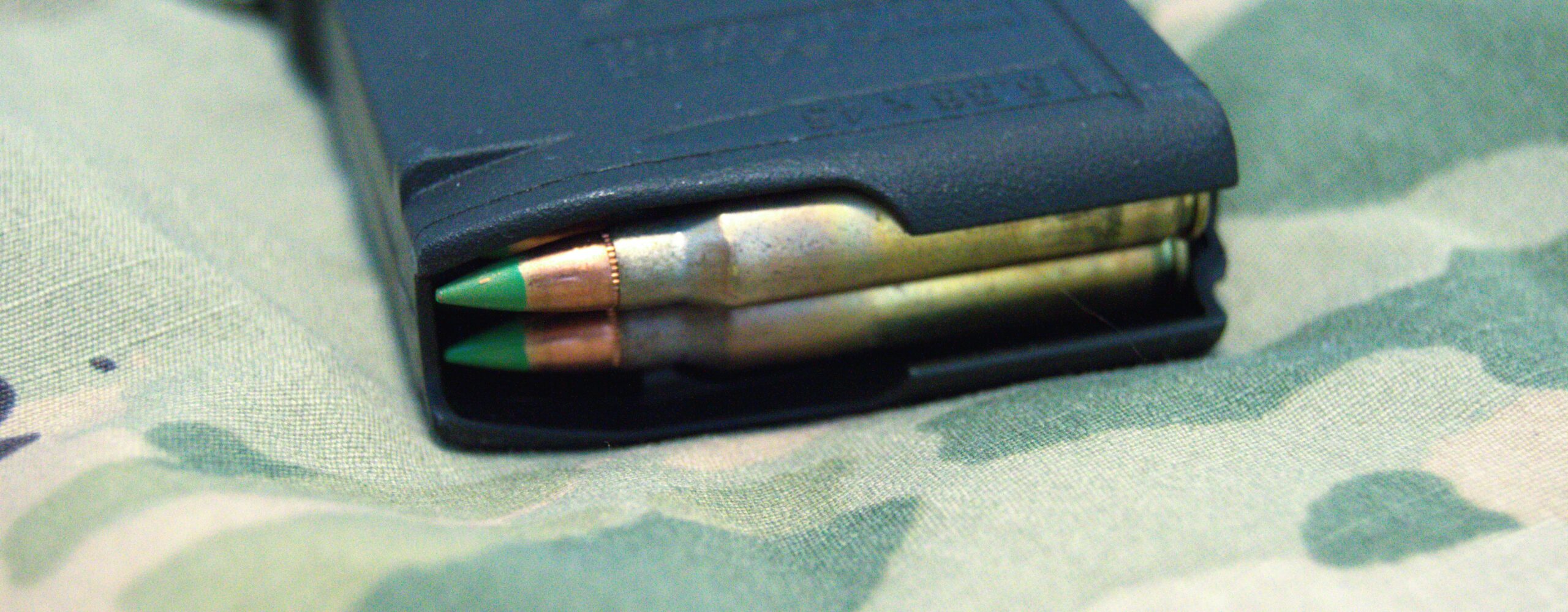
Such point is the terminal ballistics of non-hunting or self-defense bullets specific in the 223 Remington or 5.56×45 NATO. I will include Full Metal Jackets (FMJ), Open Tip Match (OTM) and steel penetrator (“green tip”, or M855 – though technically it is the wrong denomination for civilian sales and use) bullets in the lot, as they invariably get brought up along each other.
The issue
Whether found in hunting or self-defense forum posts, this point of efficient terminal ballistics in these bullets is almost always linked to their speed of impact. Most people claim these bullets will “pencil through”, meaning travel through the target in a straight line with minimal tissue damage, below a certain velocity. According to these people, the distance between the shooter and the target is the main parameter for adequate terminal effects, as the bullet slows down while it flies through the air. Within this distance, they claim you have a devastating bullet and beyond, just a bona fide ice pick.
In all fairness, I am not writing any striking new piece of science. The phenomena explained in the following lines and posts is well known and can be found discussed in certain forums, typically ones devoted to long range accuracy, or in materials written with people with field experience like elite shooters and snipers.
An interesting observation comes from reading the many pages dedicated to the use of .223 Remington/5x56x45 NATO for hunting with non-hunting bullets such as FMJs, OTMs and green tips. If we except accounts where the shots were poor (neck, angling away, etc) and focus on broadside shots, people generally report that lighter grained FMJ pills, green tips and cheap range fodder work well on smaller bodied animals like coyotes or small deer, whereas the heavier bullets in match grade loads tend to pencil through.

In the latter case, many hunters lament poor blood trails and too often lost animals. Conversely, people report better results with these precision loads on bigger bodied game animals such as large deer, black bear up to elk, again on broadside shots. When lighter bullets are used for these animals, poor results ensue, with scant blood trails and lost animals as well. For the point of this post, this is significant.
Providing that these accounts are accurate, this shows that the lighter and/or cheaper loads will release their energy quickly upon impact. The higher end loads will do that too, but a little deeper into the target. Lighter bullets will dump all their energy creating a devastating but comparatively shallow wound that will put down small game, but may not reach deep enough to quickly incapacitate larger game. Higher end loads may indeed pencil through a narrow animal and exit before they can release their energy.
The reason for such behavior is not a matter of speed, at least not at the distances where these loads are commonly used. It comes from a combination of factors linked to the construction of the bullet and its in-flight behavior just before impact. We will take a look at these in the second part of this series.