
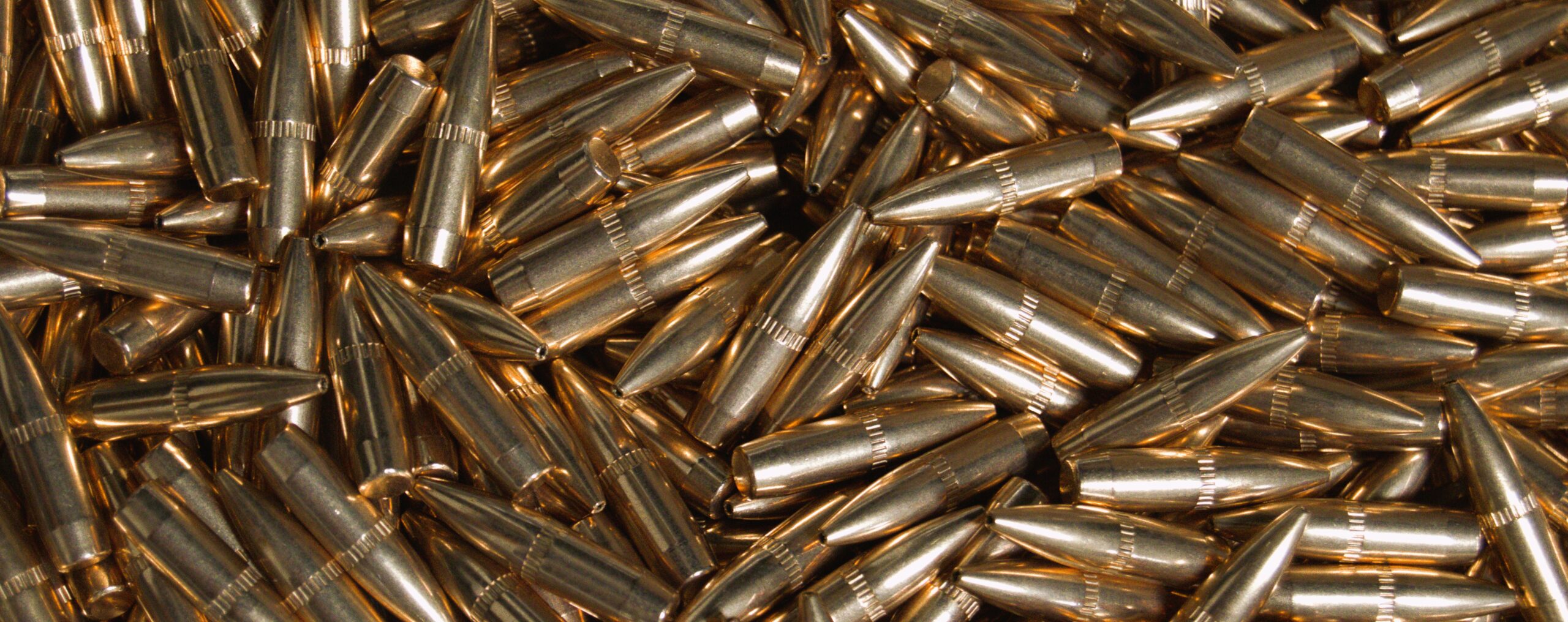
Following the initial post of this series, we need to look at the specificities of the bullets used specifically in .223 Rem and 5.56X45 NATO military loads before diving deeper into their behavior. Military bullets are very different from hunting bullets. As a matter of fact, they have to be as different from them as possible. In the early days of smokeless bottleneck cartridges, military loads were often topped with exposed lead tips. People in charge found that they were too efficient for war and decided to ban their use. New solutions needed to be found.
The bullets
I will not go into the details of the inception of the 223 Remington and its original M193 load, other than mentioning that this cartridge was designed to spit its 55-grain full metal jacketed bullet at a 3,250 feet per second velocity out of a 20 inch barrel with a 1:12 twist. Interestingly, one of the development requirements was for this cartridge and rifle combination to be as effective as the M1 Carbine, which, in itself, is a hotly debated topic.
Further down the line, NATO standardized an evolution of this cartridge in the M855 (or SS109 from its original Belgian name), a higher-pressure load involving a 62 grain bullet with a steel penetrator, a lead alloy body and copper or alloyed jacket requiring a 1:7 inch twist rate for the barrel. More recently, the exceptionally accurate M262 and its 77 grain Open Tip Match (OTM) bullet was developed and used on the battlefields for long range engagements. This load, when available for civilians, as risen to be the accuracy standard for the 5.56×45 NATO against which all other loads are compared to, and sleepless nights haunt handloaders trying to replicate this load.
These cartridges were developed for warfare, and thus bound by the different conventions regulating the terminal ballistics of small arms projectiles. Among others, they cannot be expanding like hunting ammunition. This seemingly humane requirement was and still is very probably laughed at politely behind closed doors: since these bullets were to be shot at enemy combatants, the goal was to incapacitate them as fast as possible.
The clever folks in charge of development realized that using the right construction parameters, a regulation compliant FMJ (and later OTM) bullet could come apart and/or tumble upon impact, thus transferring its energy to the target and creating devastating wounds that would make expanding bullets jealous. The cannelure that made for a good crimping point for the brass case serendipitously weakened the bullet where the jacket squeezed the lead core. As a result, the M193 would quite often break into two pieces at the cannelure, before fragmenting further depending on the energy remaining upon impact.
The M855 would do the same, with the steel penetrator ripping away from the jacket and lead core. One can imagine the kind of damage all these supersonic bits and pieces could do inside a body. OTM bullets’ construction vary, and they are liable to fragment especially if they have a cannelure and a jacket on the thinner end, but stouter and cannelure free bullets can resist fragmentation and tumble through upon impact, again, with extremely destructive effects.
The external ballistics
Since these cartridges were developed under the limitation that they could not be designed to expand, they still needed to release their energy upon impact to quickly incapacitate their target. This was done through simple physics rather than extensive bullet engineering, using the spin imparted to the bullet by the barrel’s rifling.
This brings to me a “ah-ha!” moment memory from July 2001 when my Corporal was explaining to us recruits that the standard ammunition for our Swiss Army Assault Rifle (FASS/STGW90) would penetrate better past 100 meters (111 yards) than at closer range. He told our perplexed faces that the bullets are purposefully set in the cartridge with the tiniest amount of cant at the factory. The goal is to induce an infinitesimal amount of instability, at least at close range. Upon shooting, the bullet’s axis would wobble very slightly for a tiny fraction of second before stabilizing and aligning with the path of flight.
This is much like when we spin a top. As our fingers release the spinning toy, it is rarely perfectly perpendicular to the surface it is spinning on. After a short bit of time, the gyroscopic forces straighten the top’s axis perpendicularly to the surface and the wobbling stops. The faster the spin, the quicker the stopping of the wobble. This wobble is not enough to have significant impact on the accuracy of the bullet, but as a result, the bullet would yaw and fragment quickly upon impact at closer range where this generally would be the most useful. At further range and after stabilizing, the bullet would go straight and penetrate better at longer ranges where enemies might be concealed or under cover. This was brilliant and I instantly had some further questions, and my curiosity was rewarded with 50 pushups.
The 5.6mm Gewehr Patrone 90 (affectionately dubbed the GPat) that we shot is just a Swissier flavor of the 5.56x45mm NATO, so this would apply to the M193, M855 and Mk262. Any bullet shot from a rifled barrel will spin at a rate dependent on the twist rate of the barrel and the exit velocity. Like an ol’ pigskin tossed on the football field, the elongated projectile is stabilized by the gyroscopic forces involved with the rotation of the said projectile.
A certain balance must be achieved, though. Too little spin and the bullet will go haywire and tumble in the air, dramatically losing any of its accuracy potential. Too much spin and the bullet may vibrate off axis and lose accuracy, or, to the extreme, may come apart, torn asunder by too much gyroscopic force. Bullet axis alignment is critical for maximum accuracy, as any wobble changes the ballistic coefficient until it stabilizes. Loads with poorly or inconsistently aligned bullets will have less predictable trajectories that will open up at longer range.
Depending on the quality of the ammunition and how well the bullet is aligned with the cartridge axis at the factory, the bullet’s flight will have two main phases. The first will involve some tiny amount of wobbling of the bullet axis and will stop as soon as the gyroscopic force stabilizes it. The second is a theoretically wobble free flight until the bullet reaches the target or remains in the air so long that the bullet’s spin slows down too much to keep stabilizing the projectile.
This leads us to what happens upon impact, which will be covered in the next post of this series.