
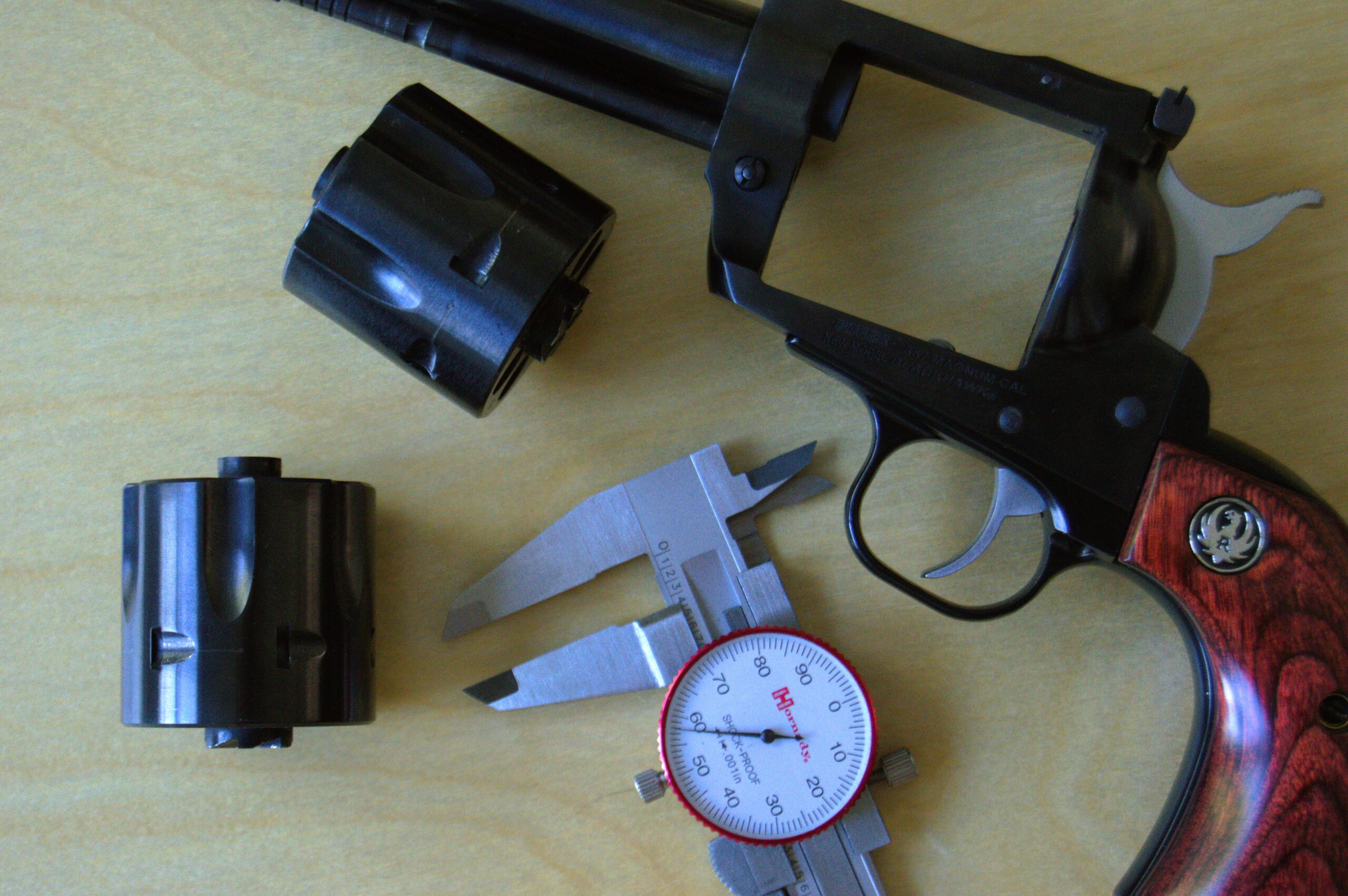
The initial post of this series showed that the Ruger Blackhawk 357/9mm Convertible can be incredibly accurate with certain types of 9mm ammunition, and do poor with other. This post presents the factors most likely to influence the accuracy of these single action revolvers.
Possible causes for accuracy variation
Rare are the guns that shoot consistently well with all sorts of ammunition. Such a gun should be treasured, and it will be sorely missed if sold or passed on. Because of their types, geometry, engineering and manufacturing tolerances, most guns are sensitive to different ammunition to a varying degree. A gun capable of shooting three different cartridges like the Ruger Blackhawk Convertible introduces a few more parameters that can influence its accuracy.
This is especially pronounced when this gun uses two cylinders with 6 different chambers each, separated from its fixed barrel by a gap. Pondering what can affect accuracy in the Ruger New Model Blackhawk Convertible, three main causes come to mind: the obvious human factor, the mechanical properties of the gun and the ammunition itself.
The first one is not completely linked to the gun but will play a critical role in shooting it accurately. There is no way to address a subjective parameter like human factor in any quantifiable way, but it cannot be dismissed. The second and third causes can influence each other, making isolating a single cause more difficult.
Human factor
The human factor is probably the most influential of all despite not being directly linked to the making of the gun. Guns are user-operated, and everybody is different. Personal experience and skill come into play, as well as normal subconscious reactions.
Firing a gun, even in a (hopefully) safe and controlled environment like a shooting range is still a rather unnatural experience. The loud report, the concussion of the blast and the recoil of the gun are sensory stimulations that induce an elevated response in most people.
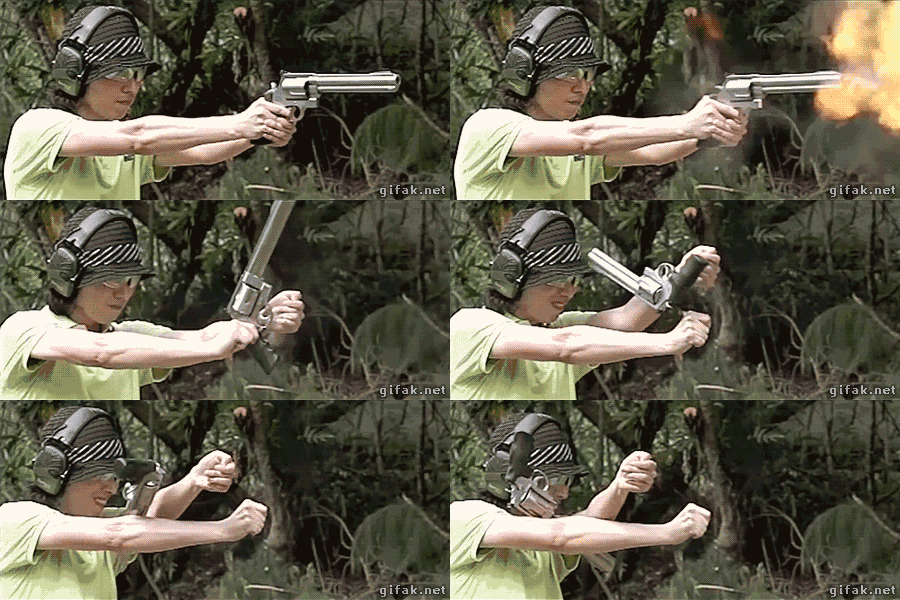
Many shooters will find less energetic loads like the 9mm Luger or 38 Special easier and more pleasant to shoot compared to full power 357 Magnum loads. Anticipating the blast and recoil may lead to flinching or variations in the grip between shots that will impact accuracy negatively.
When shooting the powerful and costlier 357 Magnum, the operator may take more time to properly adjust their shooting technique and take more time in between shots. With the lower powered chamberings, the shooter may consciously or unconsciously relax and/or shoot more casually, especially since the ammunition is a third of the price per round.
Muscular and nervous fatigue will whittle down at the shooter’s ability to perform at top condition. If one shoots the full power loads first, they may do poorer with the rest of the lower powered ammunition after having spent a good amount of time holding a 45-ounce gun like the Blackhawk at arm’s length.
Mechanical properties
The way the gun is designed and made will directly influence, if not control entirely, its inherent accuracy potential. When a gun is built for a specific chambering, adapting it to another is possible. However, it may come with a lesser performance.
Bore diameter
The first parameter is the one that is evoked almost invariably as the first and unique cause of poor accuracy in this Blackhawk Convertible: bullet diameter differences vs. bore diameter. The assumed notion is that a slender(er) 9mm bullet would not engage the rifling of a barrel manufactured to 357 Magnum specs as well as a specific 9mm Luger barrel.
The reality is – what a surprise – a little bit more nuanced than that. With regards to the barrels and per SAAMI specs, the bullet diameter difference may not be that important of an issue if at all. Both barrels specs recommend 6 grooves, a bore diameter of 0.346 inches and a groove diameter of 0.355 inches. The only difference lies in the original twist rate.
The 357 Magnum calls for 1:18.75 right hand twist rate, compared to the tighter 1:10 right hand for the 9mm Luger. It is worth noting that in the mid-nineties, the SAAMI reduced the maximum pressure of the 357 Magnum to a tamer 35,000 PSI (the Commission Internationale Permanente, the Euro version of the SAAMI, has kept the original spicy pressure of 3,000 BAR, or 43,511 PSI). Nowadays and since bullets started flying a bit slower, most 357 Magnum revolvers, such as the Ruger New Model Blackhawks, are produced with a 1:16 twist in their barrels.
Could the issue be in the bullet diameter differences? Per SAAMI specs again, the diameter of the 9mm Luger bullet should be 0.3555 ±0.0030 inches, meaning a diameter range from 0.3525 to 0.3585 inches. This should provide enough meat around the bones for the bullet to engage the SAAMI Spec rifling, even with the narrowest ones as long as they are within specs.
Barrel twist rate
One may worry that the slower 357 Magnum twist rate may decrease the stability of the 9mm Luger. A quick look at a twist rate stability calculator, such as Berger’s online tool (https://bergerbullets.com/twist-rate-calculator/), shows that even the longest bullets found in the 9mm will stabilize adequately in a 1:16 twist, even at speeds below 500 feet per second. The Ruger New Model Blackhawk in 357 Magnum and 357Magnum/9mm Luger Convertible have barrels rifled with 8 grooves at a 1:16 right hand twist instead of the SAAMI original six grooves and 1:18.75 twist rate. It is possible that this variation from the SAAMI standards impacts one chambering more than the other, negatively or positively.
Cylinder gap
Because revolvers have their chambers bored in a cylinder separated from the barrel, they need a thin amount of space between them to allow the cylinder to rotate. This cylinder gap lets some of the propellant gases escape as the bullet leaves the cylinder, passes the forcing cone and travels down the bore.
Despite operating at similar maximum pressures, the 357 Magnum has a much larger powder load, meaning that any volume of escaping gases will have a lesser impact in terms of propellent volume pushing the bullet down the bore. Fluctuations in tolerances between the two cylinders of a same gun can induce variation as well, with minute movements of the cylinder between the time the firing pin strikes and the bullet leaves the cylinder. Finally, differences in cylinder gap and end shake between the cylinders can increase the possibility and amount of accuracy variability.
The cylinder itself
Finally, the manufacturing process of the cylinder itself may lead to some potential accuracy degradation. In the case of convertible revolvers and to save costs, a manufacturer is likely to have all cylinders bored with the same inner diameter throats and ream the different cylinders’ chambers for the specific cartridge. Add to that the cutting tools’ wear and manufacturing tolerances, and you may end up with cylinders that have different throat diameters and/or elliptical throats. None of which are conducive for repeatable accuracy.
This is especially important when shooting cast bullets (their jacketed counterparts tend to be somewhat more forgiving). Wide throats may be especially detrimental when using bullets at the narrower end of the SAAMI specs. These could leave room for the gases to blow by the bullet resulting in irregular pressures, and the bullet may travel askew along the throat and enter the forcing cone slightly canted. The unpredictable location of their impact on the forcing cone may also shake the gun ever so slightly in a different direction for every shot.
Ammunition
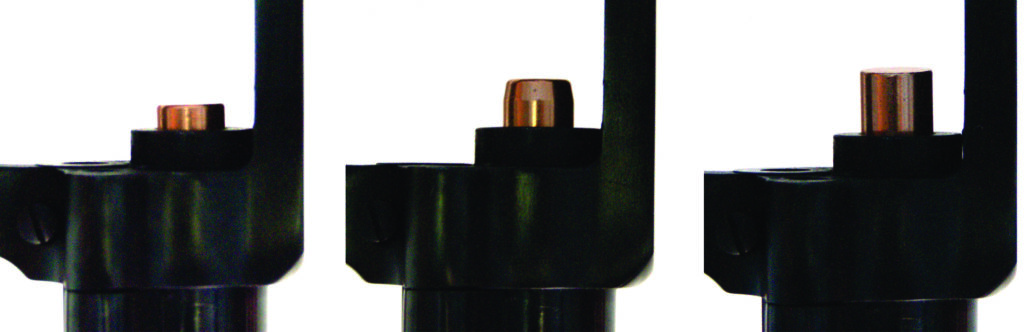
Most 9mm Luger ammunition has bullets much shorter than the 357 Magnum does. The common 9mm Luger bullet weight ranges between 115 and 147 grains. The 357 Magnum bullets are usually flat based and commonly range from 125 to 180 grains, with the heavier 158 and 180 grains weight being generally preferred.
The rear end of these longer bullets is still well supported by the throat as they make their way out of the cylinder and into the forcing cone and barrel, minimizing misalignment or yawing. Compared to the 357 Magnum bullets, the shorter 9mm bullets may not offer as long as a bearing surface to exit the cylinder and engage the rifling past the forcing cone without losing some alignment.
The 9mm Luger was developed for military purposes, and was considered as a less effective threat stopper compared to other chamberings for a long time. Recent advancements in bullet technology have made it the number one choice for self-defense in terms of ammunition and gun sales.
The self-defense or law-enforcement loads are carefully assembled with reliability and performance in mind, and this is reflected in their costs. While the 9mm Luger is used in competition, it is for dynamic courses where steel targets are involved, rarely for formal target shooting. As such, there are few affordable high-quality target loads for practice. Furthermore, most people who practice self-defense scenarios engage targets at a threatening encounter distance, rarely extending further than 15 or 20 yards.
At such proximity and with emphasis on speed, hair splitting accuracy is not required and the shooter generally chooses affordable ammunition that replicates the bullet weight of the load they use for self-defense. As a result, most range ammunition consists in the most affordable fodder meant for extended range sessions. Like for anything produced cheap and in quantity, the quality will suffer variations, and where a cartridge will perform adequately for timed 7 yards failure-to-stop drills, it may do poorly for target shooting at 25 yards.
On the other hand, the 38 Special has always enjoyed a reputation for accuracy, and most range loads are loaded a bit better for that purpose. The 357 Magnum is overkill of anything made of paper and I doubt it was ever commercially loaded at full power for casual plinking. This powerful cartridge is used mainly for personal protection, law enforcement and hunting, and practice loads are usually of higher quality, since they are meant to emulate quality loads and not expected to be shot in massive quantities. As such, the 38 Special and 357 Magnum ammunition is usually expected to be more accurate than range-grade 9mm Luger.
Wrap up
Guns are mechanically subtle systems in which a complex series of events happens between the time the shooter takes the gun in their hand and a bullet is expelled out of the barrel. All of these events and any parts participating in the shooting sequence has a bearing on the potential accuracy of the gun. In a well-made gun such as the Ruger Blackhawks, some factors can be isolated as more influential than others when it comes to accuracy.
From the initial shooting test presented in the first post of this series, it became obvious that the 9mm ammunition was the most critical component in the accuracy variations in the Blackhawk 357/9mm Convertible. Let’s have a look at the 9mm ammunition that were tested and see how their own parameter influence accuracy in the light of what is presented in this post in: “The Curious Case of the Ruger Blackhawk 357 Magnum/9mm Luger Convertible Accuracy 3: the 9mm ammunition”