
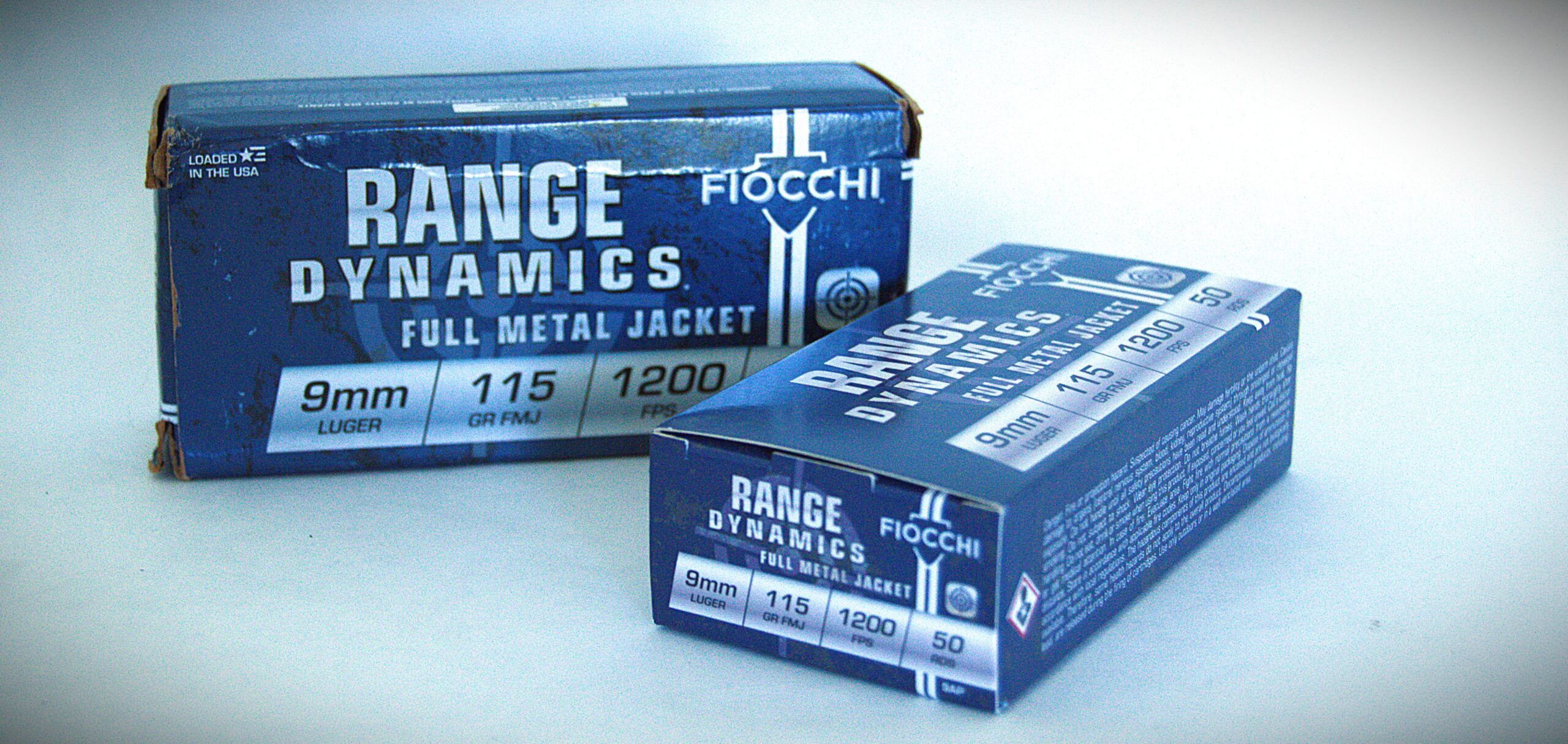
Fiocchi’s Range Dynamics line of ammunition has long been a favorite of mine for target and range practice. Unlike some range fodder, it is well made, more consistent than most, not underloaded and has never created any kind of issues in my guns. At least, until a little while back. While investigating accuracy differences in the Ruger Blackhawk 357/9mm Convertible, I ran into some pierced primer issues (read about it: https://the-blunderbuss.com/the-curious-case-of-the-ruger-blackhawk-357-magnum-9mm-luger-convertible-accuracy/). Spoiler alert, it turns out that this particular Blackhawk did not agree with this ammunition. After I had reached out to Fiocchi to make sure no recall was concerning that lot, I was very kindly sent another lot of Range Dynamics 115gr. FMJ ammunition to see if the primer issues would affect it as well (it did, for the same reasons).
I had gathered a good amount of data on these two lots to investigate this issue, and gathered more since. Here are some interesting findings on if or how significant manufacturing tolerance can affect the ballistics of these two lots in three different firearms.
The two lots
The two lots of Fiocchi Range Dynamics featured here are rather different, despite being sold under the same label and specs. The first lot (#2431011057) has brass jacketed bullets and is made in Turkey, and the second is copper jacketed and is manufactured in the US (#242601378).
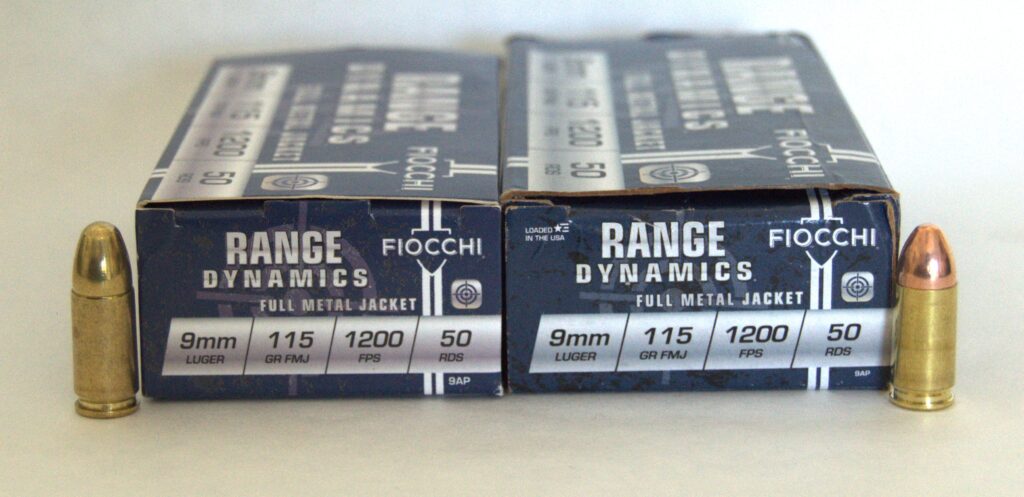
Since I originally needed to see if there were possible pressure issues with this ammunition, I had measured several parameters that I thought could influence the pressure curve. There were some noticeable differences in uniformity between these lots, the Turkish lot being significantly less consistent than the US one.
The numbers
For the original Blackhawk test, I took 20 random cartridges from each lot, and measured the bullet diameter, case mouth diameter, case length, overall length (OAL) and weight. I also visually thoroughly inspected these cartridges to see if there were any obvious visible differences in their appearance. The measurements and associated statistics are presented in the table below.
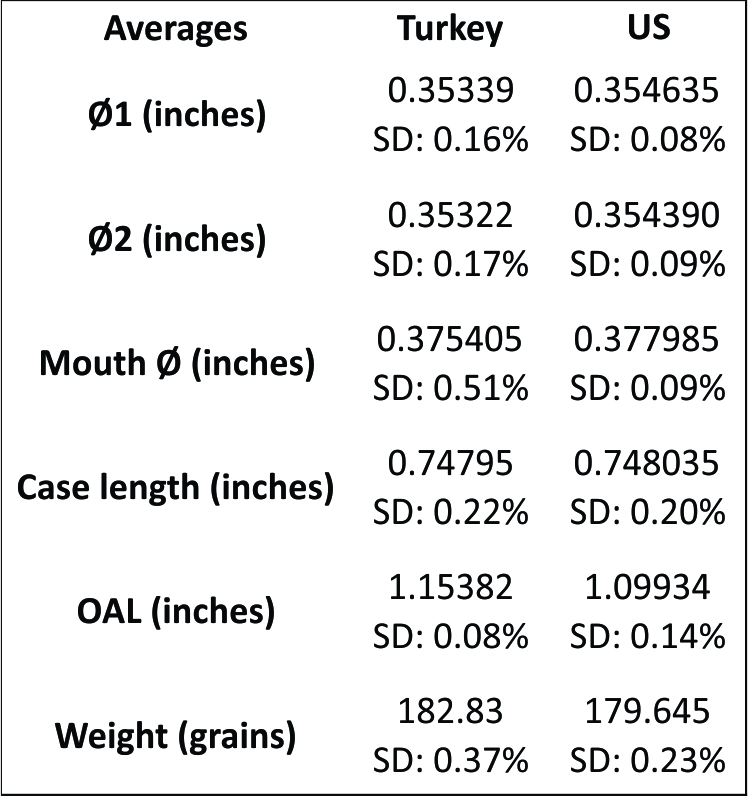
The lot made in Turkey showed a higher amount of bullet diameter variations with many having a short and long axis (elliptical diameter) rather than being rounded. Generally, the bullet diameters are towards the low end of the SAAMI spec of 0.3555 ± 0.030 inches, with three bullets out of the twenty measuring below the 0.3542” SAAMI minimum. The diameter of the case mouth shows the most variation. Some of the cases of this lot have their mouths pressed into the bullet in a taper crimp. While too much taper crimp could create pressure issues as the 9mm Luger headspaces on the mouth, I never had any issues with this in my firearms. For all the measurements, the OAL was more consistent than for the US lot.
The lot made in ‘Merica is much more consistent in terms of dimensional variations and weight than the lot coming from Turkey. In average, the bullets are 0.0012” wider in diameter, and any elliptical diameter variation is much lesser than the other lot. No “crimped” looking mouth was observed, and the case mouth diameter variations were minimal.
Visual inspection
Looking at the bullets pulled from each lots, there are a number of differences that can be observed aside from the obvious difference in the jacket material
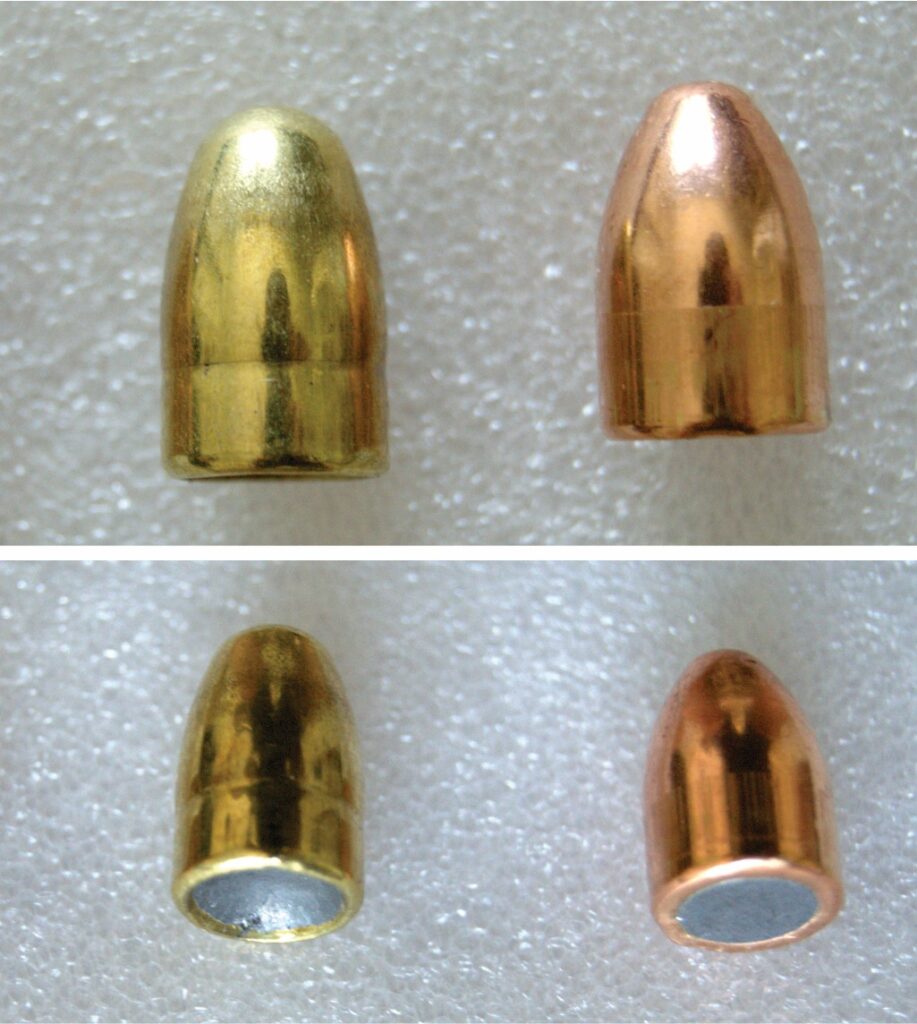
The Turkish lot shows a visible indent on the bullet where the case mouth was pressed into it. It has a shallow, hollow base, and while irregular by all standards, the base is smoother than for the US lot. On the other hand, the US lot shows no indent on the bullet, and its base is flat, with some of the swaged lead very slightly spilling past the jacket.
The guns
Since we are focusing on ammunition in this short piece of gun-nerdery, I will simply describe the firearms in which these lots ran to avoid distracting the reader with brand specific details. While you will likely be able to figure out which guns were involved, their manufacturer is here irrelevant.
The first gun is a PCC sporting a 16.25 inch barrel with a threaded muzzle, and no attachment screwed on. The action operates, like many such firearms on a simple blow back principle, with a heavy bolt assembly. I did find that the recoil was surprisingly stout for a 9mm gun, likely due to its particular ergonomics and spartan furniture. The PCC was shot at 50 yards using a Bushnell TR-26 3-MOA red dot.
The second gun is a striker fired polymer frame pistol with a match grade polygonal rifling 4.17’’ barrel. Th groups were shot at 15 yards, with a Holosun 407K 6-MOA red dot mounted on the slide.
The last gun is a full-size steel frame single action hammer fired pistol with a 4.70’’ barrel. This gun was shot with iron sights at 15 yards for accuracy.
All guns were rested on sandbags, and the 5-shot group averages at least 5 groups. Th groups are given in inches, center-to-center.
Shooting results
The table below compiles statistics made over several range sessions. Velocities were measured from a Caldwell Ballistics Pro optical chronograph placed 10 feet from the muzzle, and an Athlon RangeCraft Velocity Pro radar chronograph 5 inches to the left of the pistols’ muzzle, and 10’’ left and back from the PCC’s muzzle, as per manufacturers’ instructions. The same chronograph was used for the same gun, making velocity variations comparable for each gun. The 5-shot groups were shot rested on sandbags.
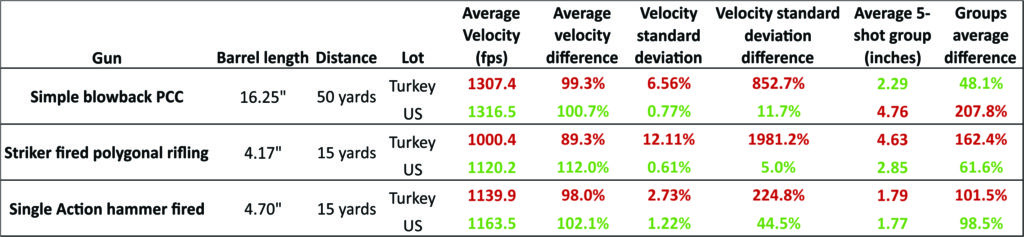
In the PCC, the Turkish and the US lots showed similar velocities, but the Turkish made ammunition exhibited much higher standard variations. Interestingly, this lot proved to be the most accurate, with groups half the size of the US made ammo. Despite having much lower velocity variation, the US lot opened its group significantly. I will hypothesize that the flat geometry and rougher base of the US bullet base lend itself to loss of accuracy at the muzzle, trumping any velocity consistency benefit.
In the striker fired pistol, the Turkish lot showed decreased accuracy and significant velocity differences compared to the US made ammunition. The average velocity is 200 feet per second slower than the 1,200 fps factory number, and the extreme spread is surprisingly high, with 306 fps separating the slowest and fastest measurements (31% of the average velocity). Despite the rather short distance, these velocity variations seemed significant enough to substantially decrease the accuracy compared to the other lot. My thought is that the generally narrower bullet did not fully seal the barrel and its polygonal rifling, letting gas flow around the bullet and resulting in erratic velocities. The US lot, with its fatter bullets, likely did not have similar issues. Lik in the PCC, the US lots showed very low velocity standard deviation.
The hammer fired single action pistol is the great equalizer when it comes to these two lots of ammunition. Both lots shot a wee slower than the advertised numbers (I suspect the factory uses a 5’’ test barrel), with the US lot showing less than half of the standard deviation of the Turkish lot. Despite its standard variation being over the double of the US lot, the Turkish ammunition did not suffer in the accuracy department, with its grouping average being virtually identical to the other lot.
My take
The Fiocchi Range Dynamics line is my go-to ammunition for the range, and not only in 9mm Luger. For this chambering, though, I will separate my lots in function of their place of manufacture. I will favor the brass jacketed Turkish made lot in the PCC, and avoid feeding it to the striker fired pistol. The copper clad US lot, on the other hand, will run in the striker fired pistol unless I need to put accuracy second behind making noise. Since the hammer fired single action pistol is equally (and greatly) accurate with both, I see no point in favoring one over the other, other than directing my monies towards US manufacturing, which my patriotic fiber leans strongly towards.